History of Military Spouse Employment Programs
I shared my employment challenges with you in previous LinkedIn articles, Employment Challenges as a Military Spouse Abroad: My Experience in Belgium and Flexible Work for Military Spouses. Last week, in My Entrepreneurial Journey, I reflected on dreaming of a dance studio in Hawaii to leading the Military Spouse Business Association (MSBA)—and explored how entrepreneurship could be a career path for military spouses. Today, I want to examine the programs designed to support military spouse employment over the last two decades. While I’m still awaiting data to dig into the numbers, I hope this overview will spark additional discussion on what we need to do differently to ensure military spouses can build meaningful careers.
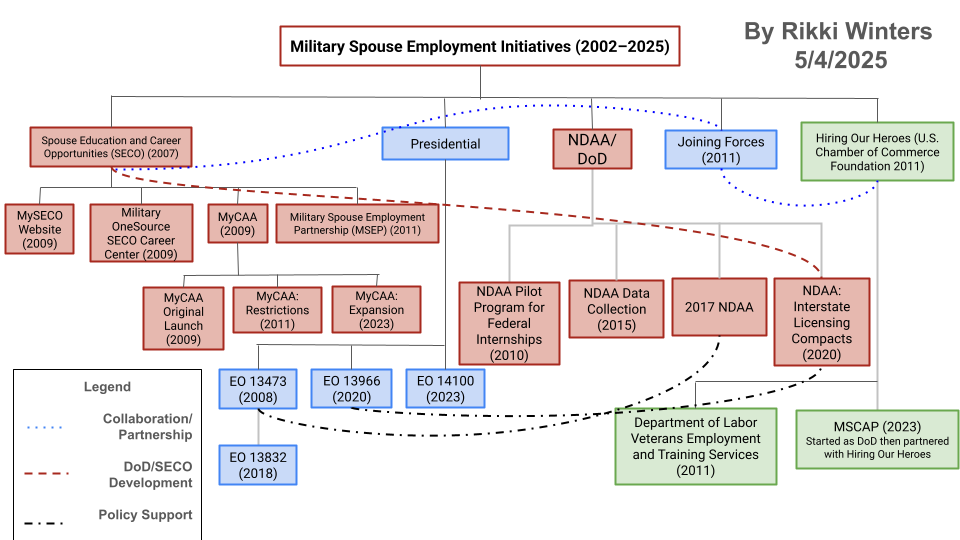
Let’s go back to 2007 when the Department of Defense launched the Spouse Education and Career Opportunities (SECO) program. This program offers career education resources to help military spouses navigate military life. Two years later, in 2009, SECO expanded with the MySECO website, an online portal for career resources, the Military OneSource SECO Career Center for free career coaching, and the My Career Advancement Account (MyCAA) scholarship, providing up to $6,000 for spouses of all ranks (except Coast Guard) to pursue training in portable careers, with no degree field limitations. I remember learning and hearing about MyCAA in 2010 and feeling hopeful. With my STEM background, I thought I could use it to refresh my engineering knowledge, retake the Fundamentals of Engineering exam, and finally feel supported in the military lifestyle. However, that thought was quickly squashed when in 2011 the program was restricted to spouses of E-1 to E-5, W-1 to W-2, and O-1 to O-2, with a reduced cap of $4,000 and limits to certain degree fields. By 2023-2024, it expanded to include E-1 to E-6, W-1 to W-2, O-1 to O-3, with a cap for E-6/O-3 spouses set at 1,250, but the $4,000 funding limit and field restrictions remained unchanged.
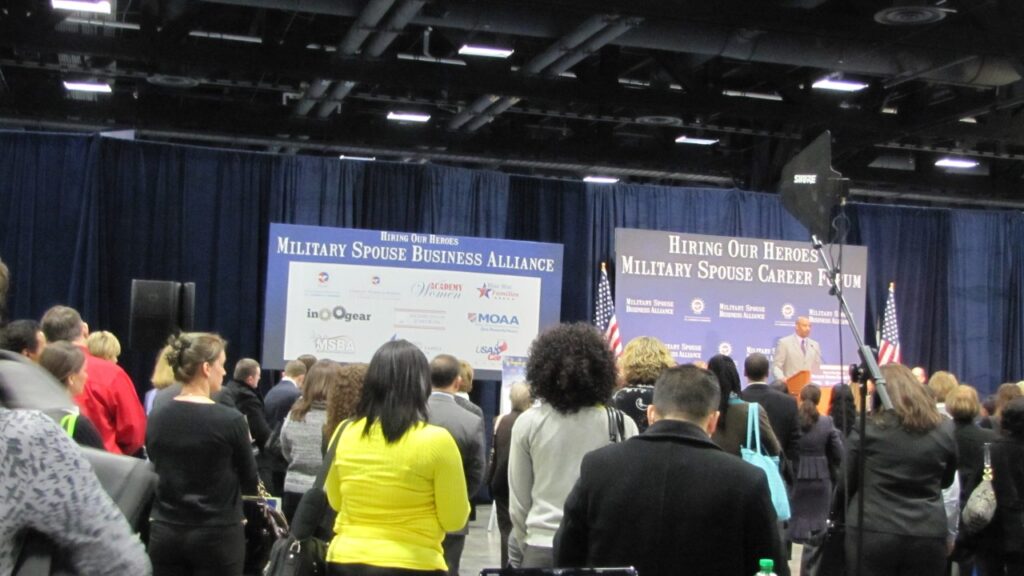
Other programs were developed to address other barriers. In 2008, Executive Order (EO) 13473 allowed non-competitive federal hiring of military spouses after a PCS move, and the 2017 NDAA removed the two-year time limit; in 2018, EO 13832 further expanded federal hiring opportunities. The 2010 NDAA launched a pilot program for federal internships for military spouses, offering another chance to access government roles. In 2011, the fourth and final main component of the SECO program, the Military Spouse Employment Partnership–MSEP, was established. It connects spouses with employers. The First Lady’s Joining Forces initiative also began in 2011, advocating for our employment through partnerships. The same year, the Department of Labor Veterans’ Employment and Training Service partnered with the U.S. Chamber of Commerce Foundation’s Hiring Our Heroes to offer job placement via hiring fairs. In 2012, the MSBA, where I served as Operations Director, was invited to join the Hiring Our Heroes Military Spouse Business Alliance. It was a wonderful opportunity to connect and share resources with military spouses interested in entrepreneurship. We partnered with other nonprofits to share resources and make a difference for all military spouses.
Most recent initiatives have focused on mobility and federal employment. In 2020, EO 13966, Increasing Economic and Geographic Mobility, changed licensing for military spouses, and the NDAA funded interstate licensing compacts to ease re-licensing. In 2023, EO 14100, Advancing Economic Security, enhanced hiring and telework for military spouses seeking federal employment, and the DoD launched the Military Spouse Career Accelerator Pilot, a 12-week paid fellowship that could lead to permanent jobs. Reviewing this chart, I see the tremendous amount of work, however, I am questioning the results and impact. When we lived in Belgium and I was looking for a second job, I tried the Military OneSource Career Coaching program and a virtual Hiring Our Heroes Career Fair. But with these resources, the complications of SOFA and NATO SOFA left me depressed and feeling unsupported as a military spouse.

I am not sure that all these programs and initiatives deal with the root cause of unemployment troubles. I don’t see a solution for portable/mobile careers, SOFA and NATO SOFA restrictions overseas, or child care concerns–I don’t have children, but I have heard many stories about spouses not being able to work because they can’t find reasonable or available childcare. The 2015 NDAA called for a review of programs and better data collection, and while I await data from my Freedom of Information Act requests, I’m eager to hear your thoughts. What has been your experience with these programs over the years? Have any made a difference for you?
Originally published on LinkedIn on May 5, 2025. [Read it here]