
My Career Journey and Program Experiences
In last week’s article, History of Military Spouse Employment Programs, I reflected on the programs built to support military spouse employment over the last two decades. This week, I want to share my reasons for unemployment over the past two decades and my experiences with these programs.
I married my sailor in 2002, and we moved to Florida. My job search was old-fashioned: I walked into the base Fleet and Family Support office, where I was handed a 3-ring binder of available jobs. I remained unemployed during our ten-month stay. We moved frequently–Texas in 2003, Florida again in 2004, Hawaii in 2005, and Virginia in 2006. I used staffing agencies to find temporary roles in Texas (3 months) and Florida (hired directly after a contract), but in Hawaii, I was laid off after a year due to a structural change, just as I was learning about deployments, leaving me physically sick from the stress. In Virginia, I operated my e-commerce business, as shared in My Entrepreneurial Journey, and joined the Military Spouse Business Association (MSBA).
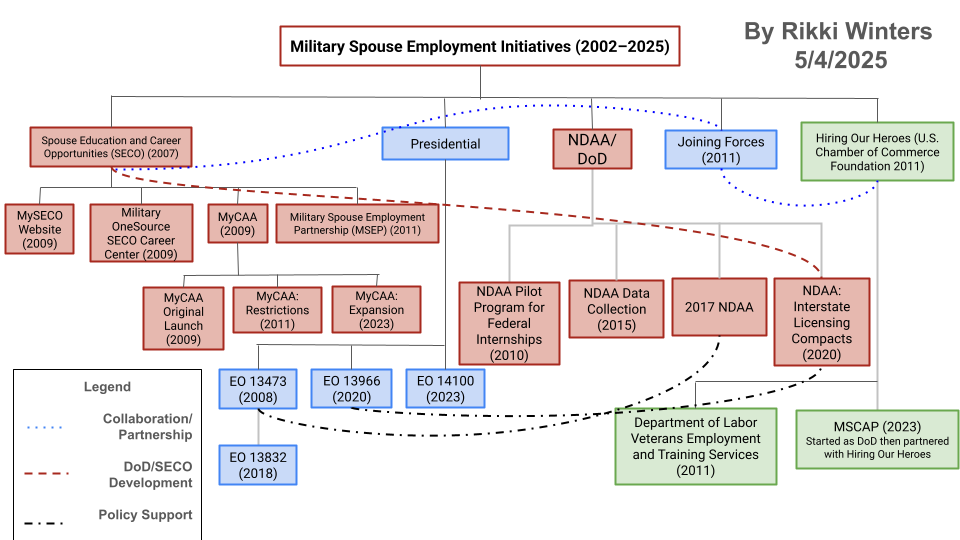
In 2010, while in California, I learned about the My Career Advancement Account (MyCAA) scholarship, offering up to $6,000 for training in portable careers. With my STEM background, I was excited, hoping to refresh my engineering knowledge and retake the Fundamentals of Engineering exam. But in 2011, MyCAA’s eligibility was restricted to spouses of E-1 to E-5, W-1 to W-2, and O-1 to O-2, with a $4,000 cap and limits to certain degree fields. I felt crushed, as the program I had hoped would support my career became inaccessible, and I didn’t engage further. We lived in California for 30 months, and I continued running my e-commerce business.
We moved back to Virginia in 2011, then to California in 2014, Virginia again in 2016, North Carolina in 2018, and Rhode Island in 2020. During this time, I volunteered with MSBA, joined the Hiring Our Heroes Military Spouse Business Alliance in 2012 to connect with entrepreneurial spouses, and later became an AmeriCorps member through Navy-Marine Corps Relief Society. A portable job in North Carolina sustained me until I was laid off in October 2020 during COVID-19. In 2021, we moved to Belgium, where I faced Employment Challenges as a Military Spouse Abroad: My Experience in Belgium. In March of 2023, I attended a Hiring Our Heroes virtual hiring fair for OCONUS spouses. I connected with two organizations, but my excitement was short-lived. One required forfeiting NATO SOFA protections, registering for a visa and paying Belgian taxes, which I decided against after researching tax brackets. If you are curious, here are the Belgian tax brackets and rates. The other had no positions in Belgium, suggesting I follow up upon returning to the United States, as the fair appeared to be catered to spouses heading back CONUS within a short period. I still had almost another year left in Belgium.
Out of frustration, depression, and anger, I connected with a MySECO Career Coach in August of 2023. I received some tips on updating my resume, which I appreciated, and created an account on MySECO, uploading my resume and creating a profile. I was told that my resume would be added to an internal job search network, with weekly emails of potential opportunities, but I never received anything. This confirmed my suspicion that the program couldn’t assist all military spouses OCONUS. I resided in Belgium for 30 months.
It would be helpful if programs like Hiring Our Heroes and MySECO clearly stated which spouses they can help–especially OCONUS–and followed up on inquiries. I would like to know what your experience has been with these programs. What are possible solutions to portable careers? What can be done to address SOFA and NATO SOFA restrictions?
Originally published on LinkedIn on May 12, 2025. [Read it here]