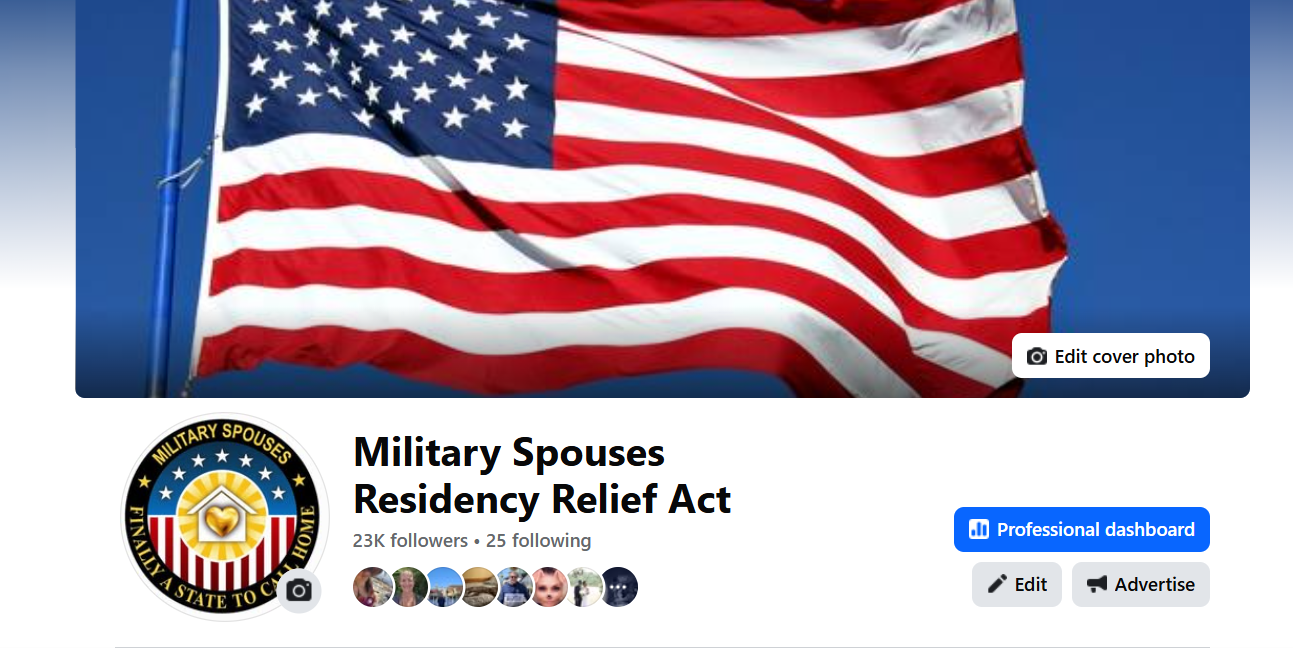
Celebrating 16 Years of MSRRA: A Personal Journey in Championing Residency Rights for Military Spouses
I didn’t get to post this on November 11th; I spent that day taking my husband out ❤️. But today I want to honor an important milestone: the 16th anniversary of the Military Spouses Residency Relief Act (MSRRA) becoming law in 2009. This bipartisan legislation, which garnered support from both Democrats and Republicans in Congress, has made a lasting difference for military families by addressing residency challenges tied to frequent moves.
My journey with MSRRA began in 2008 when I discovered the Military Spouse Business Association (MSBA) through an article in the Navy Times. I joined as a member to connect with other military spouse entrepreneurs in the area, hoping to learn from or share experiences. To my surprise, a co-founder invited me to join the board. I initially doubted myself, telling her I wasn’t the right fit, but she convinced me otherwise, and I began attending weekly meetings. It was through the board that I learned about the initiation of MSRRA. Two of the co-founders brought residency concerns to Congressman John Carter, which led to the introduction of MSRRA as H.R. 6070 in 2008. This bill amended the Servicemembers Civil Relief Act to allow military spouses to maintain residency rights for voting and taxes, as long as the spouse could prove ties to that state. It gained 72 co-sponsors from both parties; unfortunately, it is believed that due to the housing crisis, the bill did not advance that year.
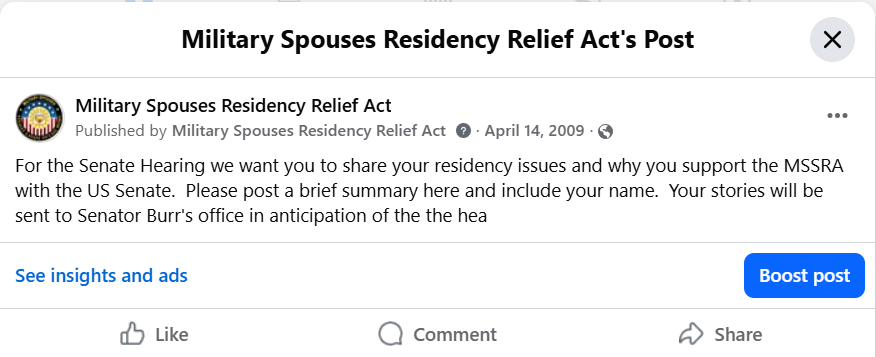
The effort didn’t stop there. In 2009, the bill was reintroduced in both the House as H.R. 1182 and the Senate as S. 475, again with strong bipartisan backing, ultimately attracting over 200 co-sponsors across both chambers. Eager to expand our advocacy beyond MSBA, I started a Facebook page in February 2009 following the announcement of the new bills. My initial posts shared my experiences with making calls to legislators, as a way to encourage others to do the same. By April, we implemented a strategy to direct efforts in alignment with the bills’ progress. We knew about the upcoming Senate Committee on Veterans’ Affairs hearing on April 29th, which had S. 475 on the docket. Using the Facebook page, we did two key things: We announced a “Surge the Senate” campaign, and we asked fellow military spouses to share their residency challenges. Those stories were compiled into a written testimony for the hearing, and my own story on residency challenges was included:
My husband signed a contract that resulted in our transient lifestyle. I support him 100% and am proud of his service. But he is also protected from the nightmares of constant moves. He does not have to worry about learning new state laws every move. I’ve received income from 4 different states that is 4 different W-2s with 4 different states of residency.
During the surge, we targeted help for specific states, posting details on who to contact (such as legislative aides), what to say when calling, and contact information for each office.
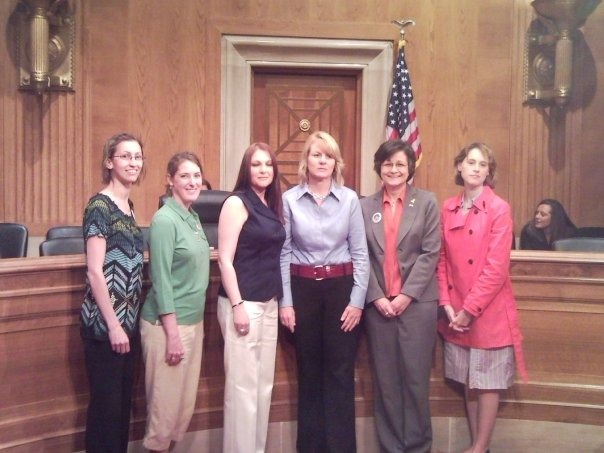
For the Senate Committee on Veterans’ Affairs hearing, my husband and I drove from Norfolk, VA, to DC to spend the day. I was honored to meet with two of the MSBA co-founders and other fellow military spouses who attended in support. The event also drew representatives from numerous supporting organizations, both in person and through written statements. These included the Military Officers Association of America MOAA, American Legion, Veterans of Foreign Wars, Iraq and Afghanistan Veterans of America, Air Force Sergeants Association, Paralyzed Veterans of America, AMVETS, and Vietnam Veterans of America.
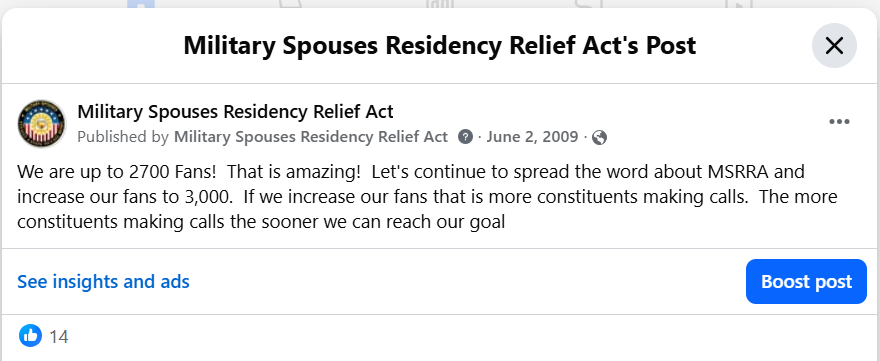
In May 2009, we shifted our focus to the House, following the same proven strategy we had used for the Senate. Midway through the month, however, we had to pivot back to the Senate as S. 475 went through a markup hearing. We rallied everyone to call Senate VA Committee members. By the end of May, we celebrated as no edits were made to the bill, allowing us to refocus on the House. Our momentum built quickly: By June 2009, the Facebook page had reached 2,700 fans, and the bill had secured 100 co-sponsors in Congress. This proved that our voices, as individuals, were not small; we were mighty, achieving real progress without paid lobbyists. Through July, August, and September, we continued sweeping each state with targeted calls.
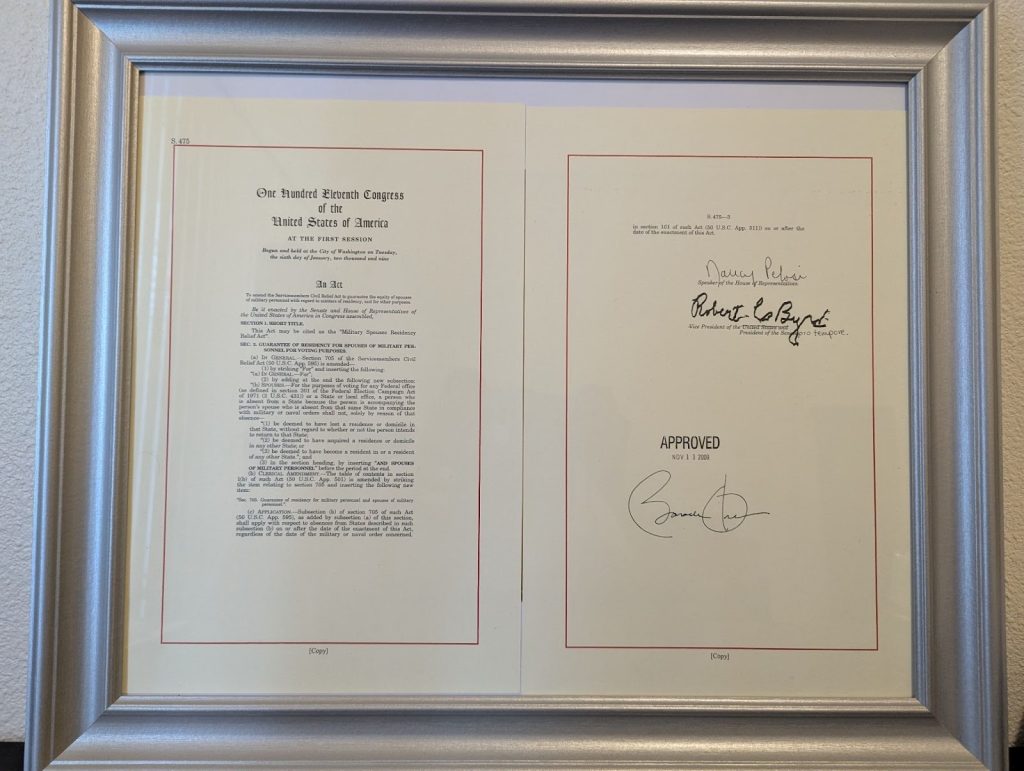
October brought a brief opportunity for MSRRA to be included in the Senate’s National Defense Authorization Act, but it didn’t happen. Undeterred, we launched a resweep of calls to the House, asking supporters to contact ten representatives a day. By November 1st, H.R. 1182 had cleared the House VA Committee and was placed on the House calendar for a vote. On November 2nd, it passed the House, and it was signed into law on Veterans Day, November 11, 2009.
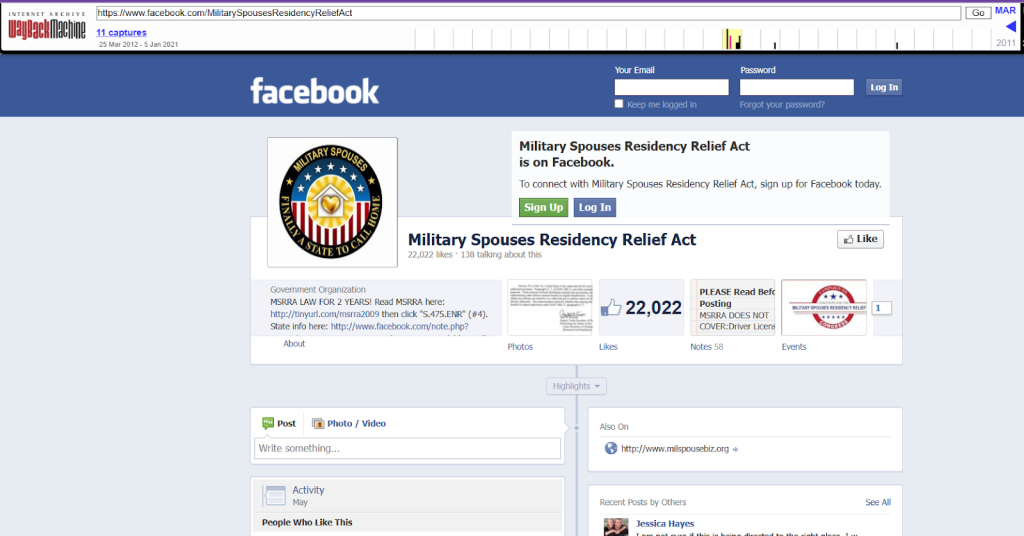
After the bill became law, the Facebook page evolved into a hub where people could ask questions and seek clarity on implementation. The page still exists today. Below is a screenshot from the Wayback Machine showing what it looked like in 2012. MSRRA has continued to evolve through bipartisan amendments, expanding its protections. For example, the Veterans Benefits and Transition Act of 2018 allowed “…the spouse of a servicemember to elect to use the same residence as the servicemember for the purposes of taxation and voting.” The Veterans Auto and Education Improvement Act of 2022 further extended this so “…the spouse of the member are authorized to elect to use the following locations for purposes of taxation:
the residence or domicile of the member, the residence or domicile of the spouse, or the permanent duty station of the member.”
I am grateful for the over 7,000 supporters who helped push for these residency rights. It shows that a group of determined individuals can drive meaningful change. I’m especially thankful to the MSBA co-founders for sparking this initiative. On a personal note, I appreciate that I can now have my name on a vehicle title without worrying about unexpected property taxes. I even registered to vote for the first time in 2012, inspired by my involvement in MSRRA and its passage. It took 15 years after the law’s enactment before we bought another vehicle, but the peace of mind it provides is invaluable.
Originally published on LinkedIn on November 17, 2025. [Read it here]